Cantus™
Saltus
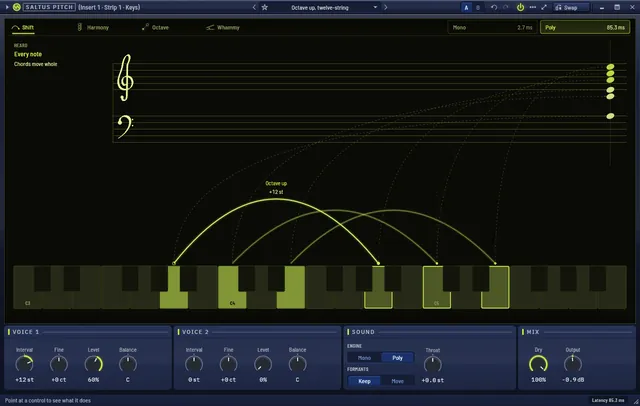
Shift, harmonise, octave and whammy in one unit — the note you play leaping to each voice across a keyboard, the music written on a staff above it as you play.
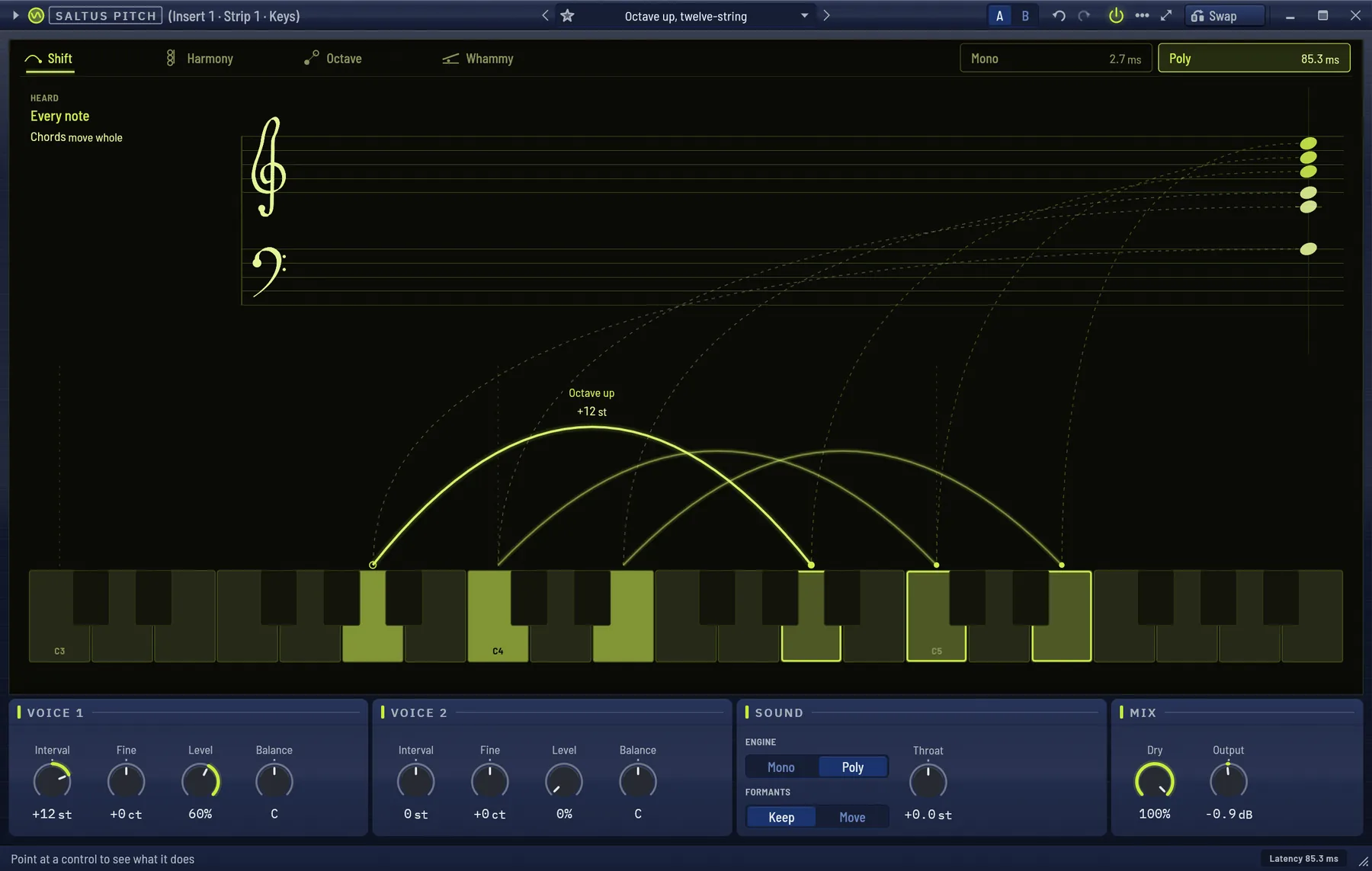
Saltus moves the pitch of what it hears four ways. Shift adds two voices at fixed intervals, by a mono engine that keeps a voice's formants at 2.7 ms or a poly engine that moves whole chords and mixes. Harmony sings two voices a number of scale degrees from the note heard — in a key, in the chords another track holds, or the melody it plays — keeping the singer's own bends. Octave adds one and two octaves down and one up, from an analog-style divider with no latency or clean. Whammy sweeps a voice from heel to toe with a pedal you rock — or that a held note presses. The engine switch shows each engine's latency, and the factory presets come in both.
Hear its presets
- Without the effectfour chords (Am, F, C, G at 90 BPM) on a DI electric guitar
- Octave up, twelve-stringBus — Rock, Worship · Gospel
- Octaves both waysBus — Ambient · Cinematic, Worship · Gospel
- Wide doublerVocal — Pop, Rock
- Dive bombCreative — Rock, Film · Game
Rendered by Cantus from its factory presets, each matched to the dry take's loudness by a gain alone, with no processing after.
Guitar: Carbonthief, CC0 (Strummed Guitar Chords, DI)
What stands out
- Mono at 2.7 ms with the formants kept, or poly for chords at 85 ms
- Harmony in a key, on another track's chords, or singing its melody
- An analog octave down with no latency, or a clean one
- A whammy rocked by hand, by automation or by held notes
- The input delayed, to the bit, at its defaults; latency reported exactly
- Eighteen factory presets in both engines; choose its starting preset
Try it
Choose a preset and play. Switch dry and wet while it plays: only the effect comes and goes.