Cantus™
Fervor
Seven saturation models, including a curve you draw, level-matched so louder never wins.
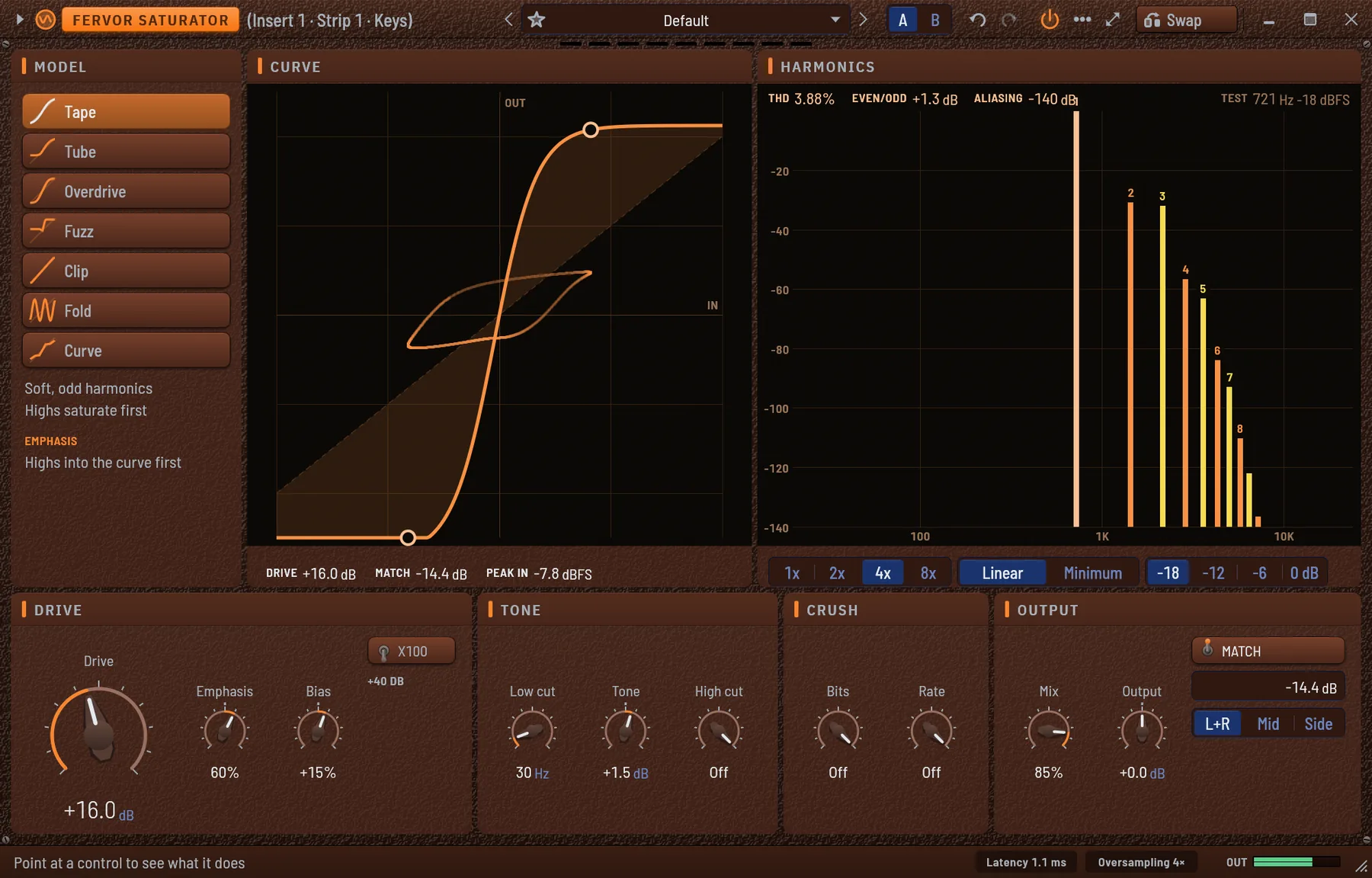
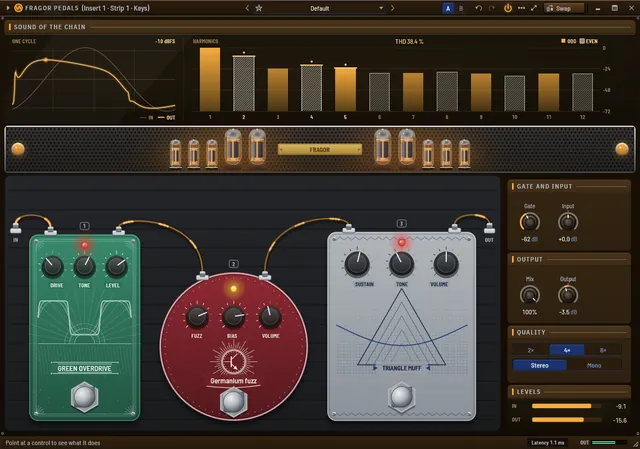
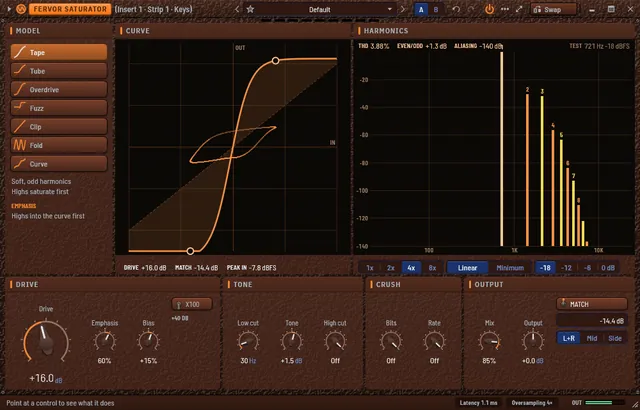
Fervor bends a signal through tape, tube, overdrive, fuzz, clip, fold or a curve you draw, oversampled up to 8× with linear- or minimum-phase filters. A bias adds even harmonics, filters before and after shape the tone, and the editor measures the harmonics of a test tone, with aliasing shown in red.
Hear its presets
- Without the effecta small mix: recorded drums, bass and the DI guitar
- Without the effecta recorded drum kit, rock at 90 BPM
- Without the effecta spoken voice
- Tape on the busBus — Pop, Rock
- Tape-crushed drumsDrums — Lo-fi, Rock
- Tube vocalVocal — Pop, R&B
Rendered by Cantus from its factory presets, each matched to the dry take's loudness by a gain alone, with no processing after.
Guitar: Carbonthief, CC0 (Strummed Guitar Chords, DI); drums: Gogodze Phu Vol. II by Karoryfer Samples, CC0, played by Cantus's Tympanum; bass: Cantus's Gravis · Drums: Gogodze Phu Vol. II by Karoryfer Samples, CC0, played by Cantus's Tympanum · Voice: Britton Rea, public domain (Wikimedia Commons)
What stands out
- Tape, Tube, Overdrive, Fuzz, Clip, Fold and a drawn Curve of up to 16 points
- Oversampling 1× to 8×, linear phase (47–57 samples) or minimum phase (5–8)
- Static level match at −18 dBFS RMS: it never pumps, and the gain is shown
- Harmonics display: even and odd in two hues, aliasing in red, THD readout
- Bias, low cut before and high cut after the curve, tilt, bit and rate reduction
- Stereo, mid only or side only; dry/wet with the dry path delayed to match