Cantus™
Loquax
A vocoder that makes any voice speak through a synthesiser played by your notes, through another track or both — the bands lit by the voice, the levels drawn with the mouse.
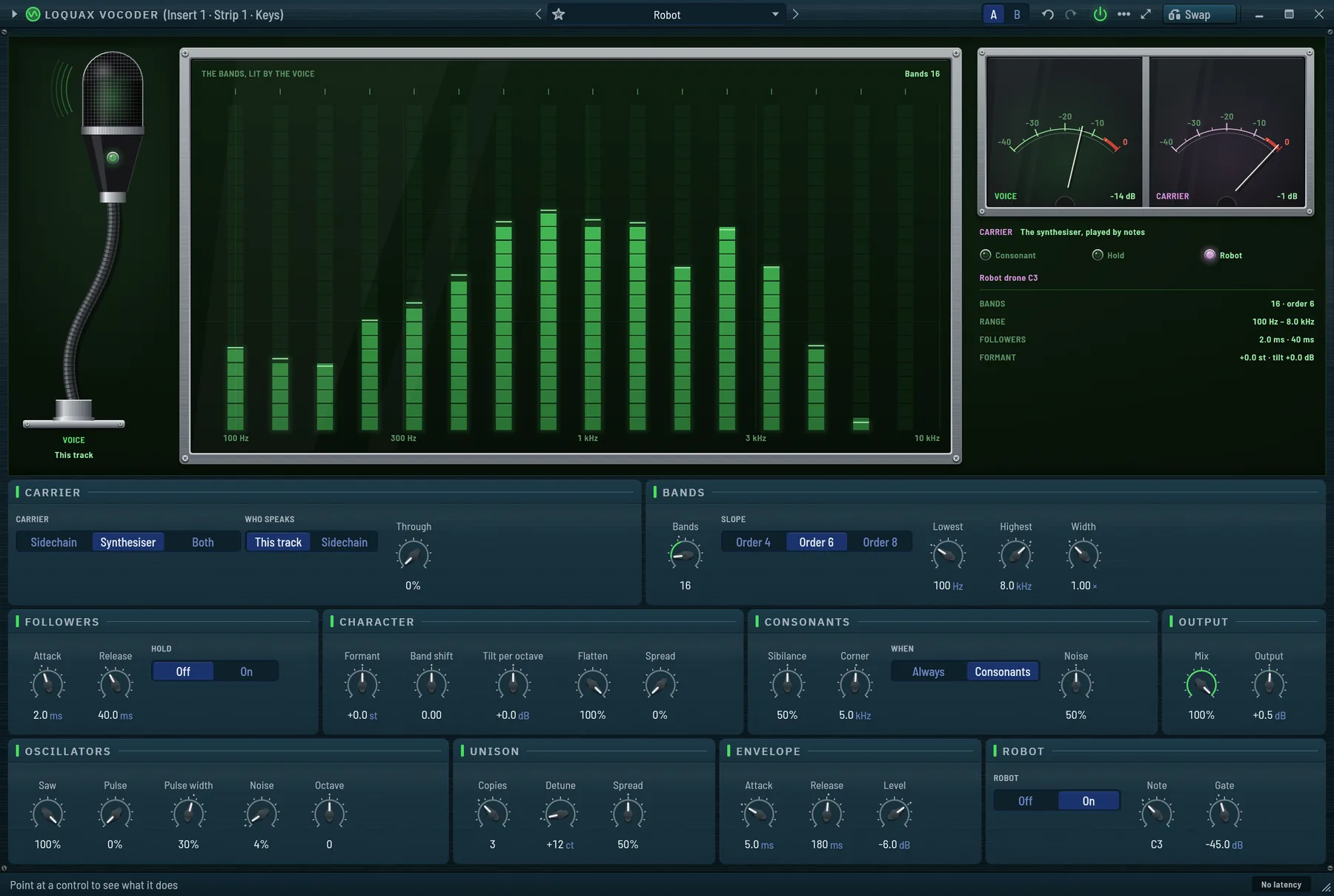
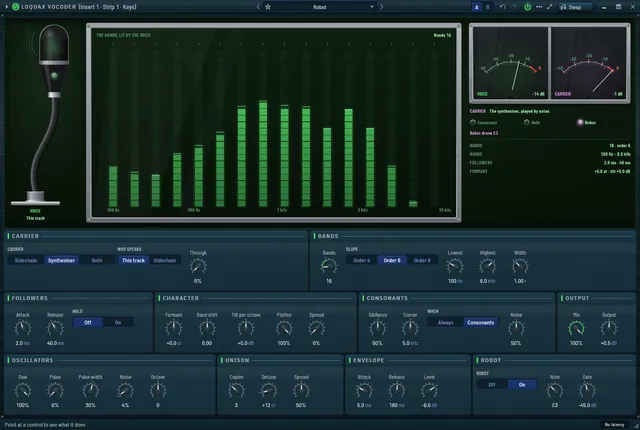
Loquax splits a voice into 8 to 64 bands, follows each band and lays it on the same band of a carrier: its own polyphonic synthesiser played by the notes of any track, another track's sound on the sidechain — a pad, a guitar for a talk-box, a loop — or both. The robot drones a note with no notes at all; the roles can be traded so drums speak; the consonants come through; the formants move without moving the notes; a hold freezes the vowel. Its window is a vocoder's deck: the voice speaking into a gooseneck, a talk-box's tube or a desk microphone, the bank's screen lit band by band where you draw each band's level, and the meter bridge's two needles. At its defaults it passes the sound untouched.
Hear its presets
- Without the effecta spoken voice (the Gettysburg Address read by Britton Rea, public domain); the synthesiser plays Am, F, C, G at 90 BPM
- RobotVocal — Pop, House · EDM
- Classic vocoderVocal — Pop, House · EDM
- Choir padVocal — Ambient · Cinematic, Worship · Gospel
- Deep robotVocal — Trap · Hip-hop, Film · Game
Rendered by Cantus from its factory presets, each matched to the dry take's loudness by a gain alone, with no processing after.
Voice: Britton Rea, public domain (Wikimedia Commons)
What stands out
- 8 to 64 bands with slopes of order 4, 6 or 8, measured against the analytic response
- A polyphonic synthesiser played by any track's notes, or another track on the sidechain, or both
- A robot that needs no notes; the roles traded so drums talk
- Consonants through, formants moved, the vowel held
- The band levels drawn on the bank; a gooseneck, a talk-box tube or a desk microphone to speak into
- Fifteen factory presets; no latency; untouched at its defaults
Try it
Choose a preset and play. Switch dry and wet while it plays: only the effect comes and goes.