Cantus™
Aula
A real room's reverb from its impulse response, at zero latency, with the response drawn as you shape it.
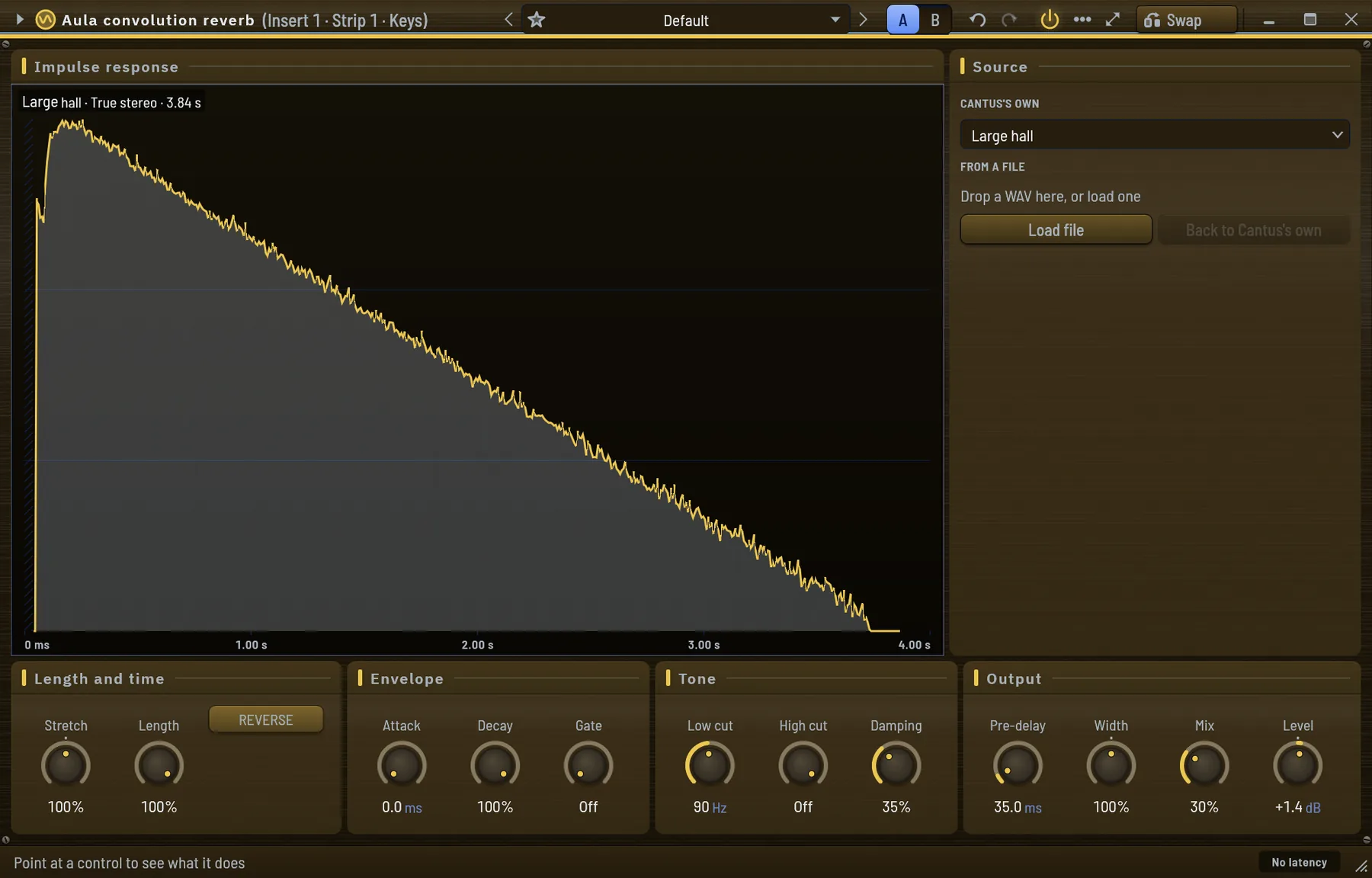
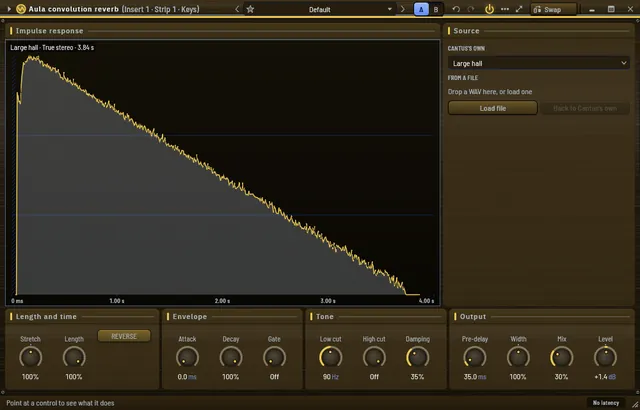
Aula convolves the sound with an impulse response: a recording of how a room answers a click. It plays fifteen rooms, chambers, halls, plates and springs made by Cantus itself, your own WAV, AIFF or FLAC files — mono, stereo or true stereo — and a free pack of eight real spaces from the OpenAIR library. Stretch, length, decay, a gate, damping and cuts reshape the response itself, and the editor draws it as it will sound.
Hear its presets
- Without the effecta recorded grand piano
- Without the effecta recorded drum kit, rock at 90 BPM
- Without the effecta spoken voice
- Hall at 25 %Bus — Film · Game, Worship · Gospel
- Drum roomDrums — Pop, Rock
- Vocal plateVocal — Pop, R&B
Rendered by Cantus from its factory presets, each matched to the dry take's loudness by a gain alone, with no processing after.
Piano: Salamander Grand Piano V3 by Alexander Holm (FLAC edition by FreePats), CC BY 3.0, played by Cantus's Chorda · Drums: Gogodze Phu Vol. II by Karoryfer Samples, CC0, played by Cantus's Tympanum · Voice: Britton Rea, public domain (Wikimedia Commons)
What stands out
- Zero latency: the first 64 taps in direct form, then partitions growing eightfold, each one's work spread evenly over the blocks before it is needed
- Within 0.000031 % of a direct convolution (−130 dB of the peak), the same bits at any block size
- Mono, stereo and true-stereo (four-channel) responses at 16, 24 or 32-bit float, any rate, up to 20 s
- Fifteen responses made by Cantus, and a free CC BY pack of eight real spaces, credited
- Stretch, length, attack, decay, a gate on the noise floor, low and high cuts, damping, reverse
- A new response swaps in whole without a click, the tail of what played kept