Cantus™
Cribrum
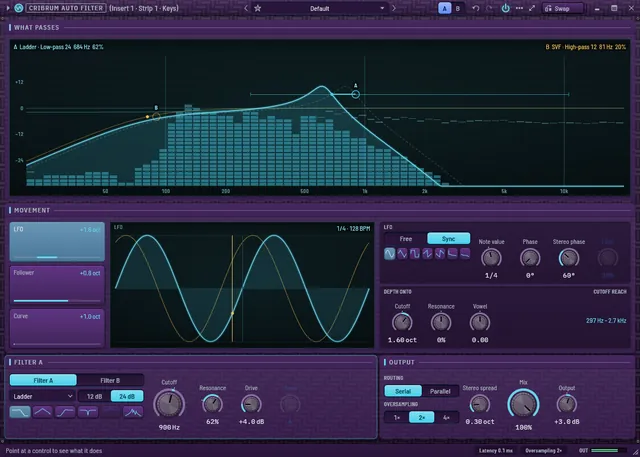
Two analog filters moved in time with the song, over a picture of the music they sieve.
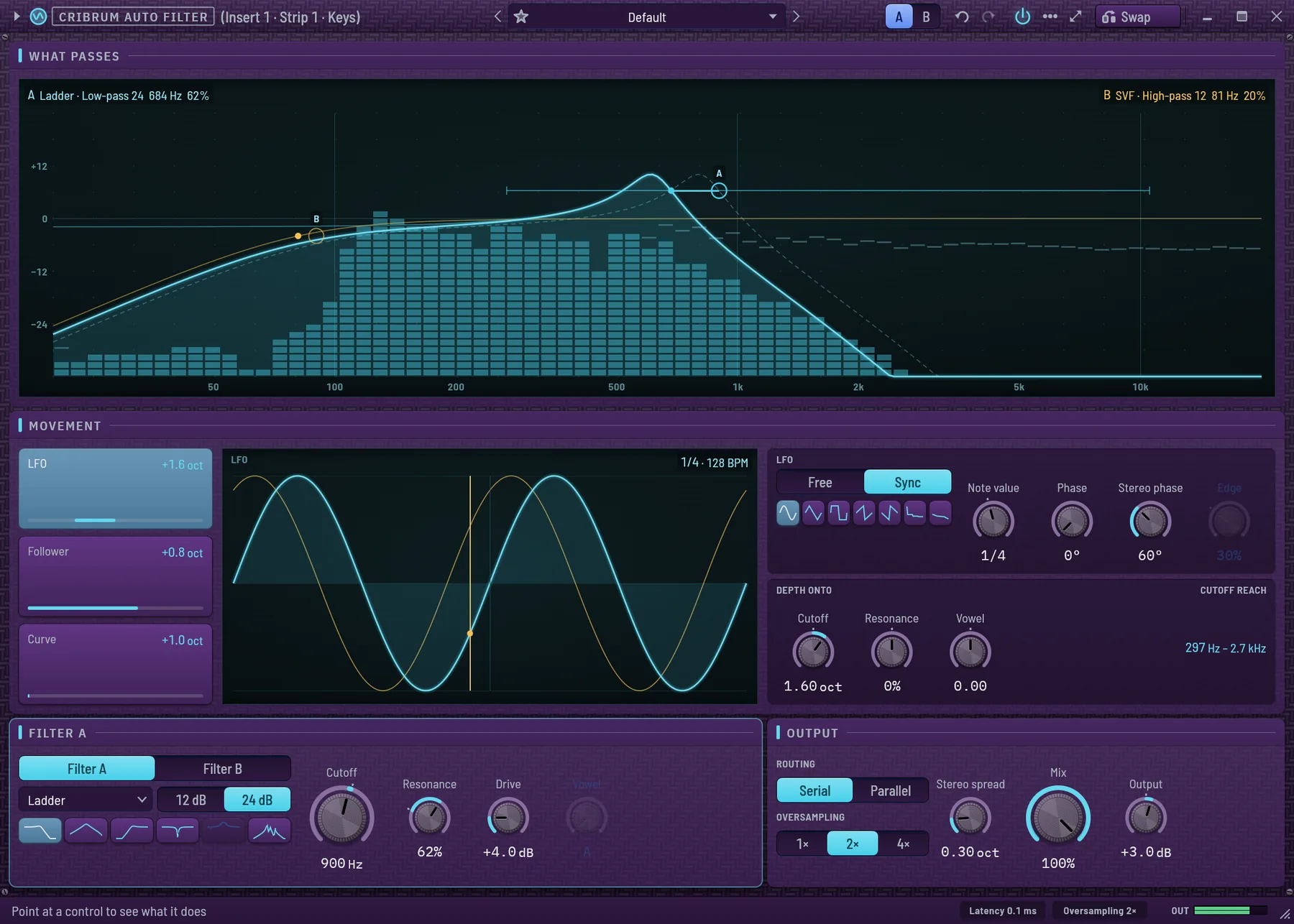
Cribrum (Latin for a sieve) is two analog-modelled filters — the same five circuits as Cantus's synths: state-variable, transistor ladder, OTA cascade, diode ladder and Sallen-Key — in series or in parallel, moved by an LFO on the song, an envelope follower on the track or a sidechain, and a curve you draw. Each source has its own depth onto the cutoff, the resonance and the vowel. Its window draws the music sieved: the spectrum as grains, lit where it passes and dimmed where it is held back, under both filters' responses as they move; drag a filter's handle across for its cutoff and up and down for its resonance.
Hear its presets
- Without the effectfour chords (Am, F, C, G at 90 BPM) on a DI electric guitar
- Cry wahCreative — R&B, Rock
- Funk quackCreative — Pop, R&B
- Bar sweepBus — Pop, House · EDM
- Talking leadVocal — Pop, Film · Game
Rendered by Cantus from its factory presets, each matched to the dry take's loudness by a gain alone, with no processing after.
Guitar: Carbonthief, CC0 (Strummed Guitar Chords, DI)
What stands out
- Five filter circuits, low/band/high-pass, notch, peak and a talking vowel filter, 12 or 24 dB/oct
- Resonance that sings in tune: self-oscillation within ±5 cents, measured
- An LFO from 1/64 to 8 bars on the song, an envelope follower with sidechain, a drawn curve
- Follows the song position: a render from any bar matches the full render, to the bit
- Two filters in series or parallel, a stereo spread, oversampling up to 4×
- Three envelope wahs, dub sweep, pump filter, talking lead, telephone, rising build, acid and more
Try it
Choose a preset and play. Switch dry and wet while it plays: only the effect comes and goes.