Cantus™
Chorda
A grand piano played from its physics — strings, felt hammers, a soundboard, half pedalling — or a recorded piano with its own mixer.
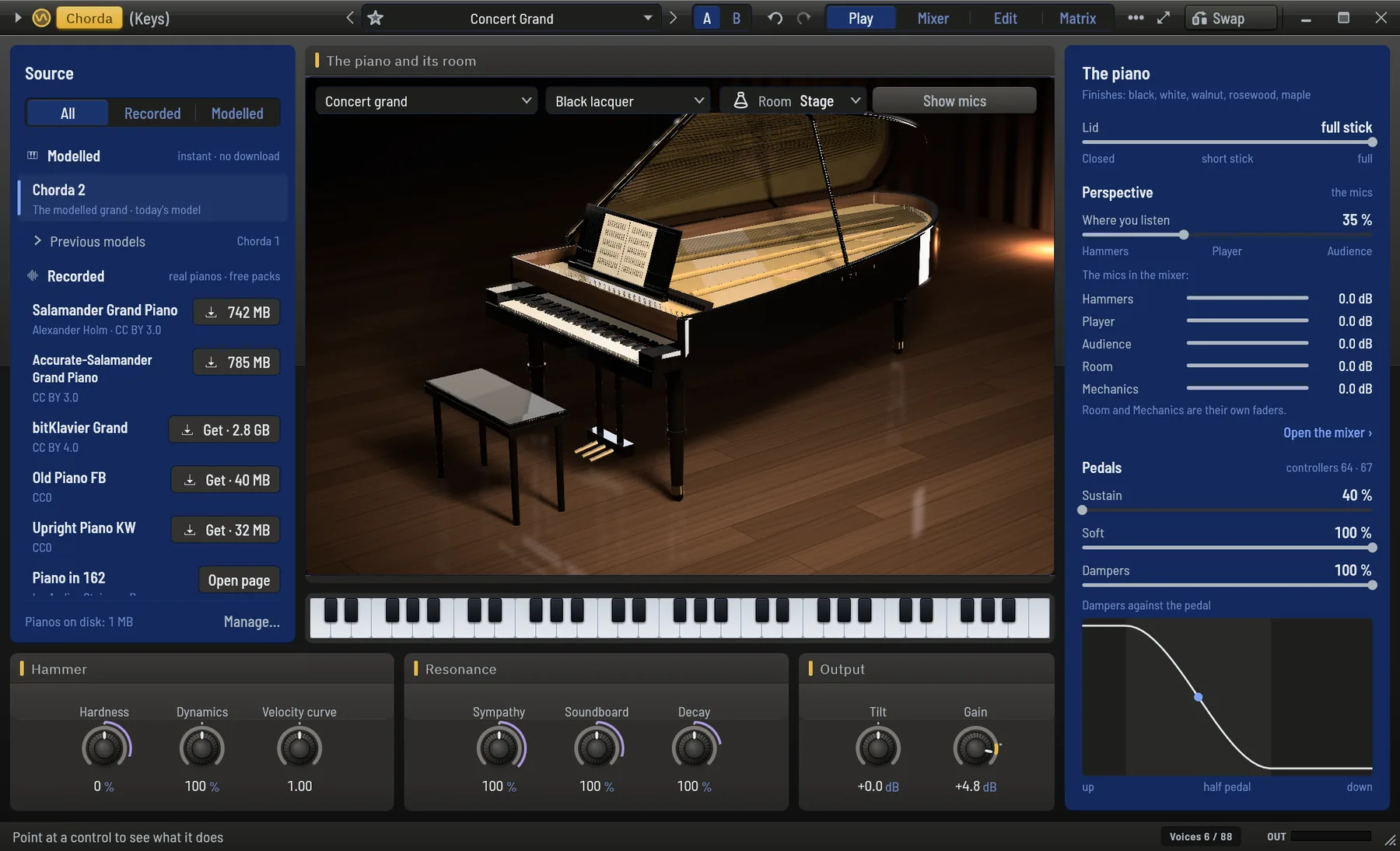
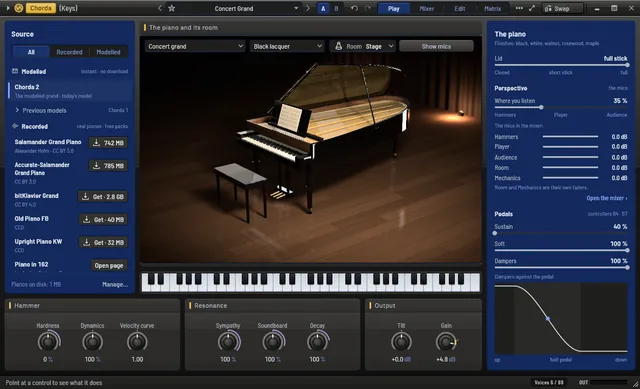
Chorda plays a grand piano from a physical model: each key's one to three strings struck by a felt hammer, meeting at a yielding bridge and ringing into a soundboard, with the other strings ringing in sympathy as their dampers allow. No sample excites anything; its numbers come from published measurements. It also plays recorded pianos — the Salamander Grand, bitKlavier's microphone images, Accurate-Salamander, two uprights, or your own SFZ, Decent Sampler or SF2 — each microphone and noise a named output in its own mixer, one click from a strip of its own, and the model's perspectives too. Its window is the piano in its room — drawn by default, photographic if you choose: the lid that opens, the microphones where they stand, the room chosen from a chip.
Hear its presets
- Concert GrandKeys — Film · Game, Worship · Gospel
- Pedal WashPad — Ambient · Cinematic
- Studio BrightKeys — Pop
- Jazz ClubKeys — Jazz · Soul
Rendered by Cantus from its factory presets, each at its own level, with no processing after.
What stands out
- Worst partial within 0.5 cent on the rendered sound, across all 88 keys
- Continuous sustain pedal with half-pedalling; the soft pedal shifts the hammers
- Sympathetic resonance of the other strings and a 40-mode soundboard
- Stretched tuning 0–200 %, string stiffness and A4 from 415 to 466 Hz
- Recorded pianos too: the Salamander, bitKlavier, two uprights or your own SFZ, Decent Sampler, SF2
- Its own mixer: each perspective a named output, one click from its own strip